Mazes: One Way Through, and How to Find It
Go in at the gap in the top wall, come out at the star. Between the two there is exactly one way through, and every other passage is a wrong turn that ends, sooner or later, in a dead end. You can play a maze here with a finger, a mouse or the arrow keys, or print a pack of fresh mazes with the answers on the back page.
🧭 The Rules
- Start in the top-left square and reach the star in the bottom-right square.
- You can step to the next square up, down, left or right, but never through a wall.
- There are no loops and no closed-off rooms. Every square can be reached, by one path only.
🌳 What Makes a Maze “Perfect”
Maze makers call a maze like this a perfect maze: no loops, and no part walled off from the rest. With no loops there is one path between any two squares, so there is one route from start to finish and no “shorter way” to hunt for. A perfect maze of 300 squares has exactly 299 openings between squares. One fewer and some square is sealed off. One more and you have made a loop.
We don’t take that on trust. In a test of 1,200 mazes, 100 at each size and level, a separate search counted the routes from start to finish in each one and found exactly one every time.
📏 What Easy, Medium and Hard Mean Here
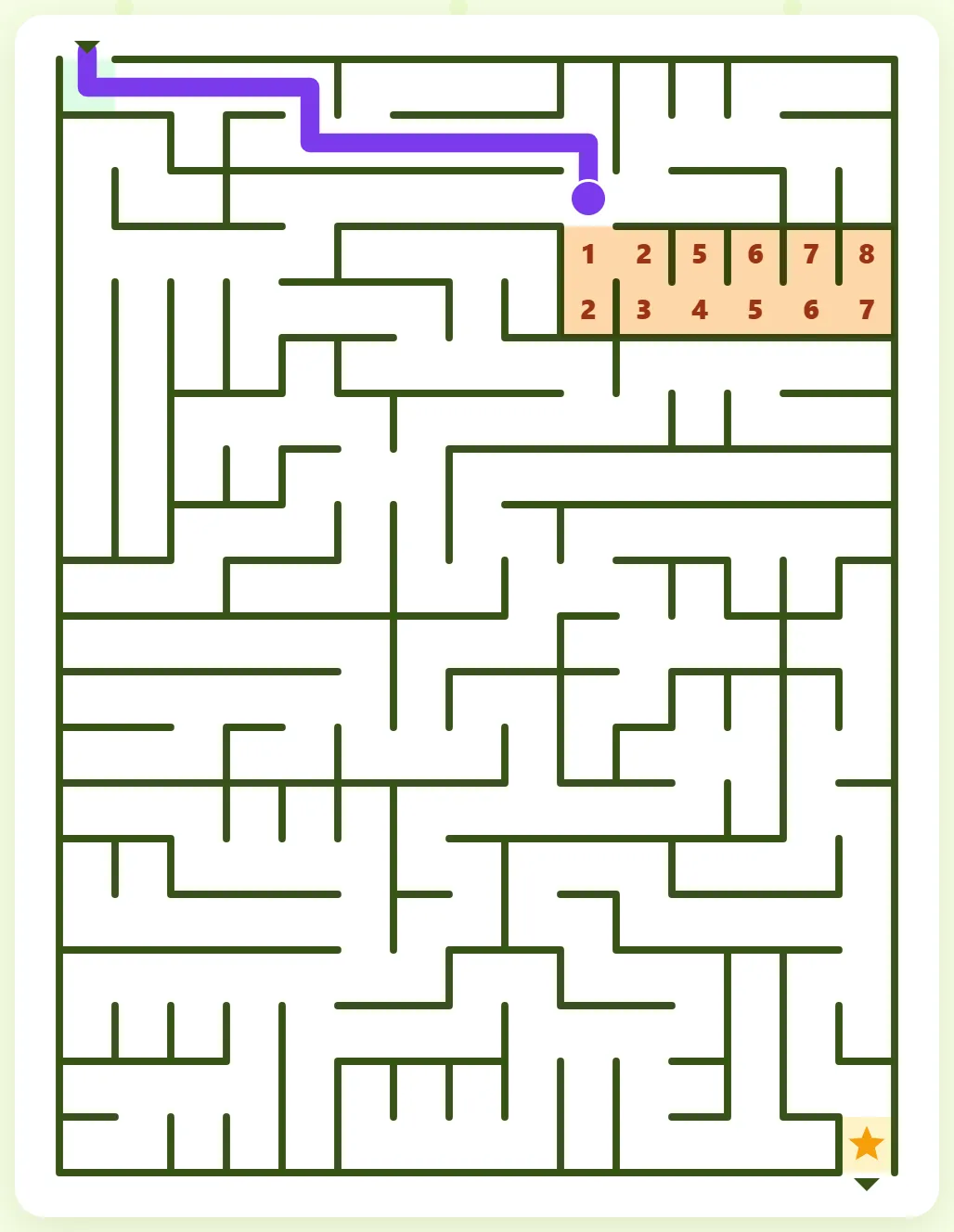
Most maze sites have an Easy, Medium and Hard, and for most of them it means a bigger grid or thinner paths. Here, size is its own setting. The level is about one thing: how deep a wrong turn can run. A wrong turn is any passage that leaves the route. Its depth is the number of squares you can walk down it before you reach its farthest dead end.
| Level | The promise, checked on every maze | Route | Wrong turns |
|---|---|---|---|
| Easy | No wrong turn runs deeper than 3 squares | 165 steps | About 57, none deeper than 3 |
| Medium | None deeper than 8. At least three deeper than 3, holding a third of the maze | 97 steps | About 31, of which 16 deeper than 3 |
| Hard | At least three deeper than 8, holding half the maze. No upper limit | 63 steps | About 18, of which 5 deeper than 8 |
The two right-hand columns are typical figures for the Standard 15 × 20 size: the middle value from 100 mazes at each level.
On Easy you can always see where a wrong turn ends from the fork, so you never really get lost. On Medium a wrong turn can swallow up to eight steps before it gives itself away. On Hard a single wrong turn can hold a big piece of the maze: the deepest one we met on a Standard maze ran 64 squares before its last dead end.
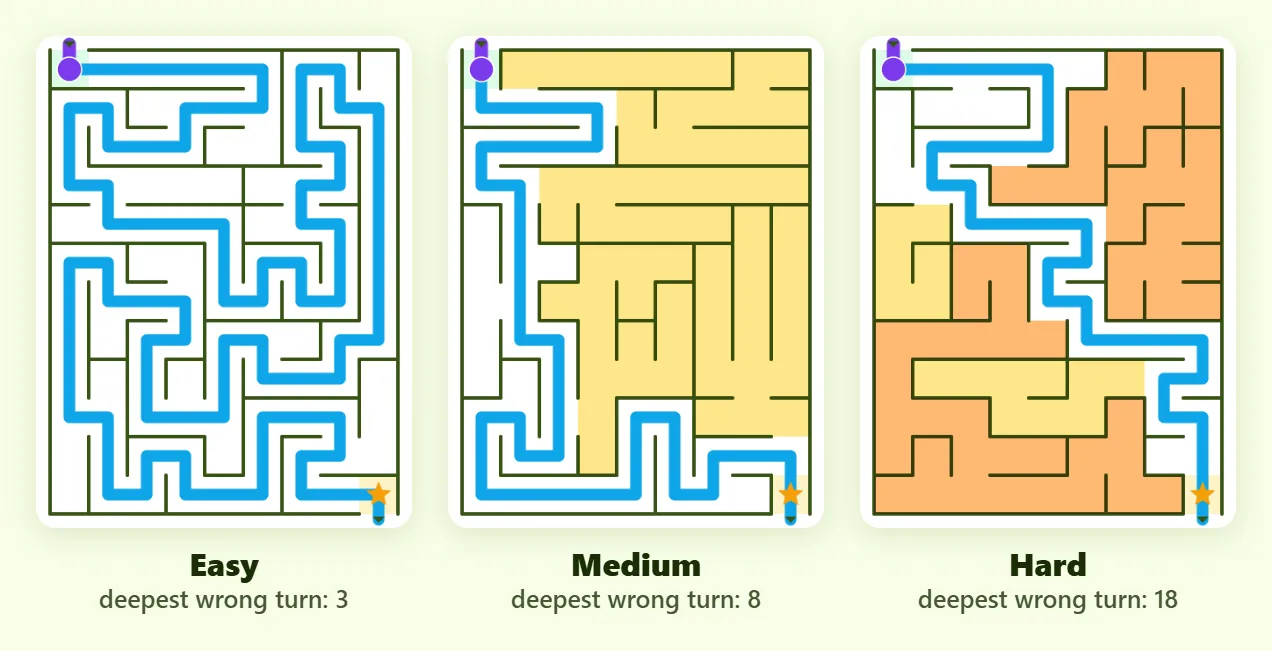
To check the levels are real and not just labels, we sent a simple walker through all 1,200 test mazes, ten times each. It can see three squares down a passage and never enters one whose end it can see. At every other fork it picks at random. On Easy it never took a single wrong step, in 4,000 runs. On Medium it walked about 1.6 to 1.8 times the length of the route. Give the walker eight squares of sight and Medium becomes perfect too, while on Hard it still walks between 1.7 and 3.2 times the route, more as the maze gets bigger.
| Size | Squares | Easy route | Medium route | Hard route |
|---|---|---|---|---|
| Small | 9 × 12 | 63 | 35 | 27 |
| Standard | 15 × 20 | 165 | 97 | 63 |
| Large | 21 × 28 | 323 | 181 | 93 |
| Giant | 30 × 40 | 646 | 344 | 158 |
Typical route length in steps. The Small size has only 108 squares, so three deep wrong turns are a tight fit there and Small Hard is only a step up from Small Medium.
✋ The Right-Hand Rule, and When It Fails
The oldest maze trick: put one hand on the wall as you walk in and never take it off. Follow that wall round every corner and into every dead end, and it will lead you out. On this page it always works, with either hand, because a perfect maze has no loops: every wall is joined to the outer wall, so the wall under your hand runs unbroken from the entrance to the exit.
What nobody tells you is the price. The rule walks you down every wrong turn on one side of the route and back out again. Between them, the left hand and the right hand walk every passage in the maze exactly twice (we check that on every maze), so on average the rule costs one trip down every passage: 299 steps on a Standard maze, whatever the level. On Easy that is about 1.8 times the route. On Hard it is nearly 5 times.
And it does fail elsewhere. In a maze with loops, some walls stand free like islands, joined to nothing. If the goal sits in the middle of such a maze, as it does in many hedge mazes, your hand can follow the outer wall all the way round and bring you back to the entrance without ever reaching the goal.
✏️ Dead-End Filling: The Pencil Method
On paper there is a slower method that cannot go wrong. Find a dead end and shade it, back along its passage, until you reach a fork. Do the same for every dead end you can see. Shading some passages turns the forks behind them into new dead ends, so go round again. When nothing is left to shade, the only white squares on the page are the route.
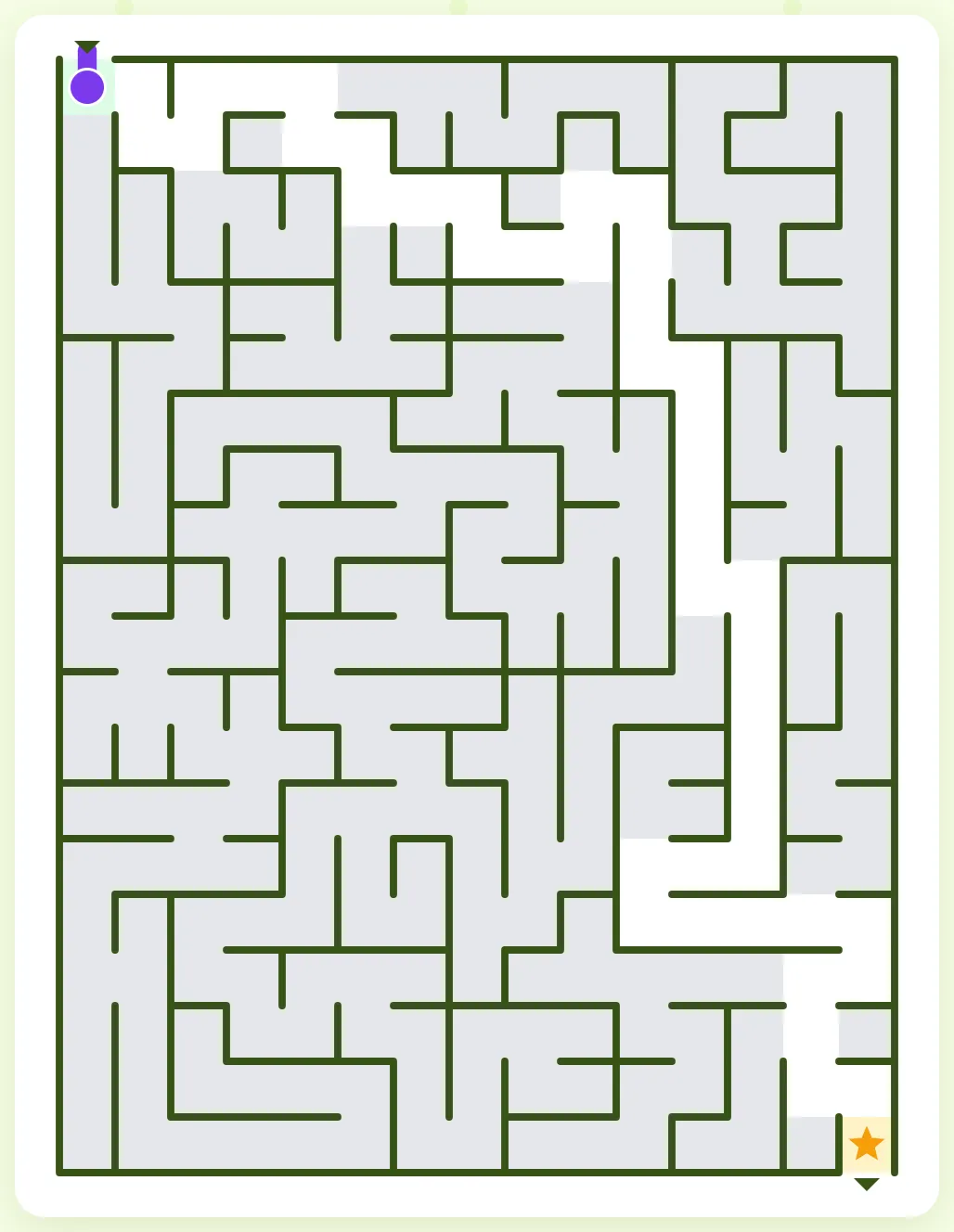
It works for the same reason the wall rule does: with no loops, everything that is not the route is a wrong turn with a dead end at the far end of it. About a quarter of the squares in these mazes are dead ends (between 22% and 26% at every size and level), so the first pass alone clears a good part of the page.
⚠️ Four Mistakes Worth Avoiding
- Heading straight for the star. The finish is down and to the right, and the route mostly is not. On a Standard maze a straight walk would be 33 steps; the real route runs about five times that on Easy, three times on Medium and two times on Hard. A passage that points the wrong way is often the right one.
- Trying the same passage twice. At a fork, mark the way you came from and the way you are trying. On paper a small dot at the mouth of a passage is enough.
- Swapping hands. The wall rule only works if you keep the same hand on the wall from the first step to the last.
- Expecting it to be easier backward. In hand-drawn mazes it often is, because the artist sets the traps for someone coming from the start. Here the same forks and wrong turns wait at either end.
🖨️ Printing a Maze Pack
Open Make a printable maze pack under the board, choose how many mazes (1 to 10), a size, a level and US Letter or A4, and press Download. The PDF is built in your browser, with no email address and nothing to sign up for. You get one maze to a page and an answer key at the back with the routes drawn in, four to a page. There is a name and date line for classes, and Different mazes swaps the whole pack for new ones.
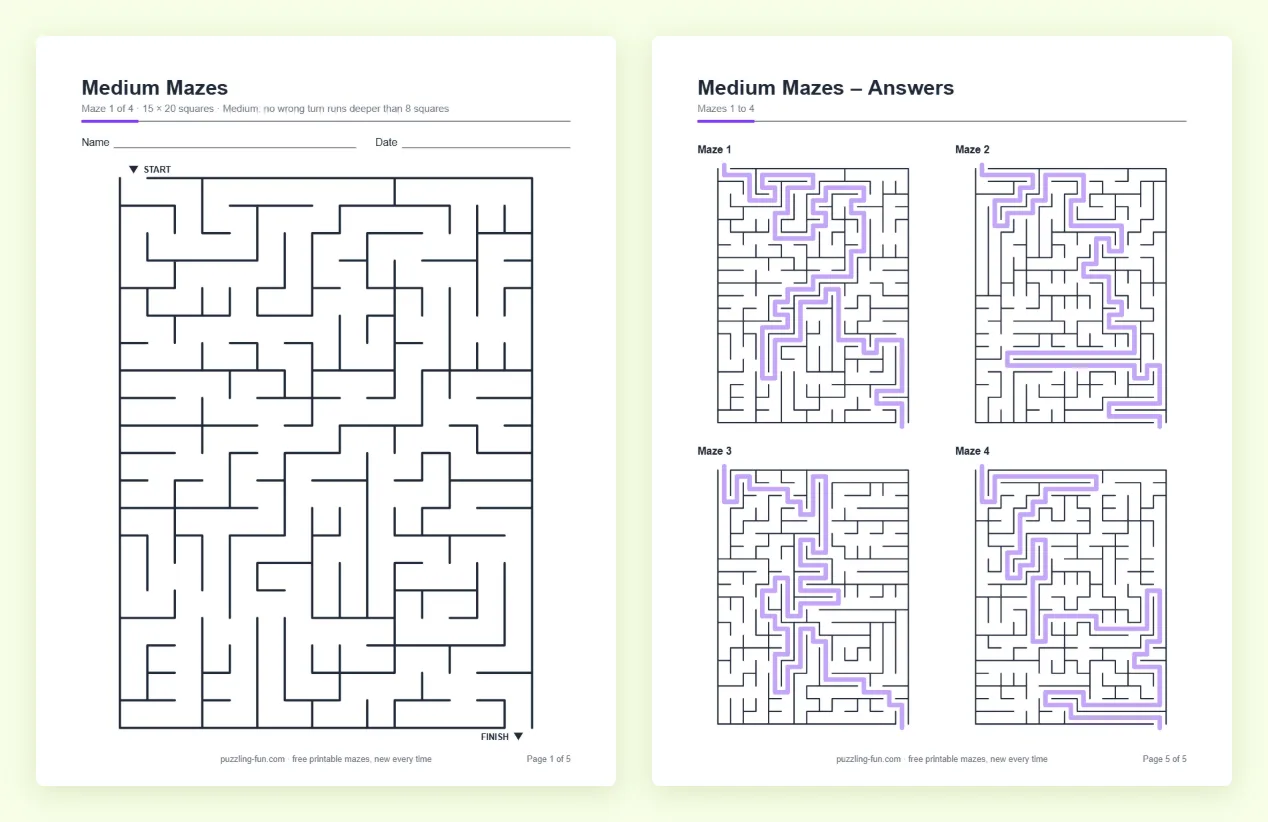
On Letter paper a square of the Small maze prints about 18 mm (0.7 in) wide, which is roomy enough for a crayon. Standard squares are about 11 mm, Large about 7.5 mm, and Giant about 5 mm (0.2 in), which wants a sharp pencil. The level’s promise is printed under the title, in words.
🎮 Playing on This Page
Drag the purple dot along the passages, or tap a square a few steps away and the dot walks there. Tap anywhere on your own trail to go back to that point. On a keyboard, the arrow keys or W A S D run the dot along the passage until the next fork or dead end; hold Shift to take one step at a time.
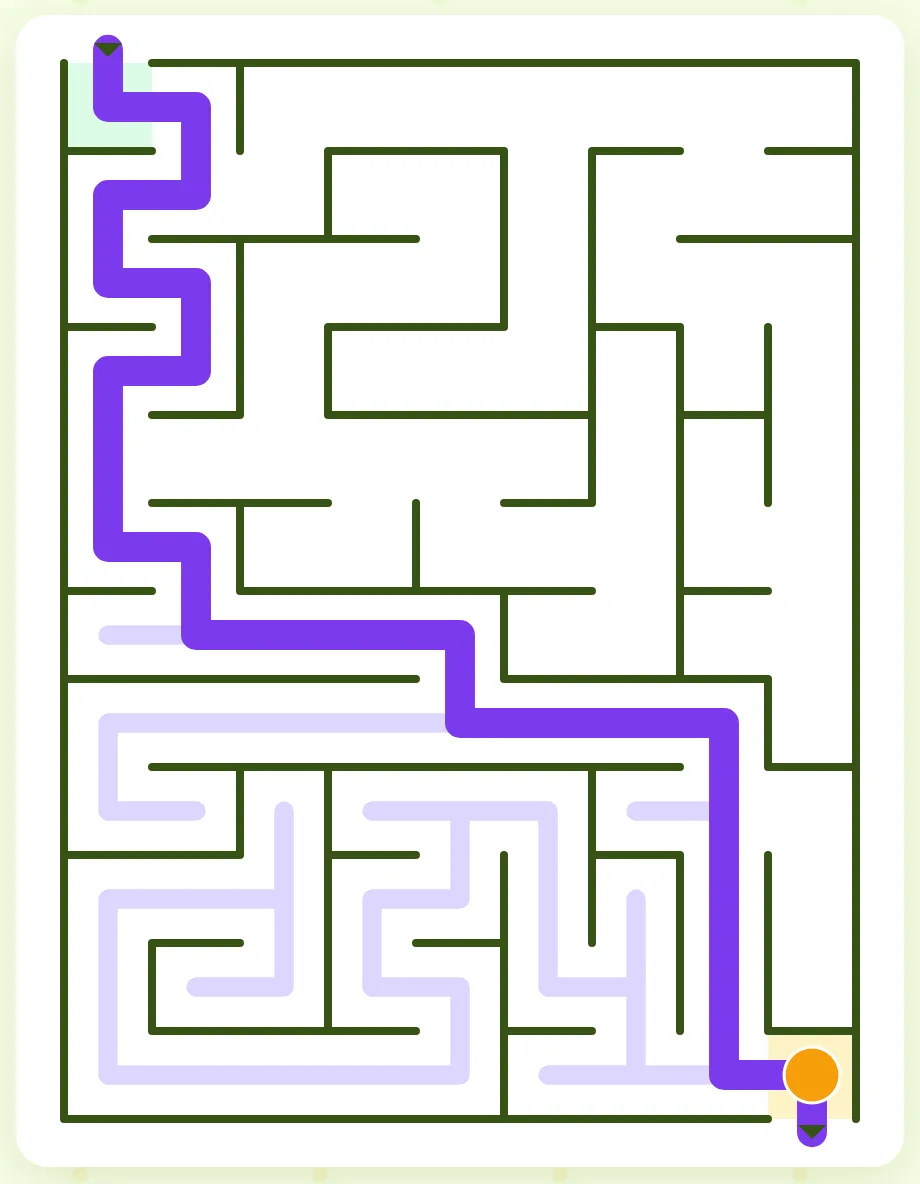
Passages you have walked and left stay marked in pale purple. Hint does one of two things: down a wrong turn, it shades the whole wrong turn gray and puts you back at the fork; on the route, it walks you on to the next fork. Start Over clears your trail on the same maze, and Solution draws the way through in blue. At the finish the page tells you how many steps you took and how many the route needed.
📜 Mazes and Labyrinths
The two words are often swapped, but puzzle people keep them apart. A labyrinth has a single winding path with no choices at all: you cannot get lost in one, only take a long time. A maze has forks. The hedge maze at Hampton Court Palace near London, planted in the 1690s for William III, is the oldest still standing in Britain. In the 1800s the French engineer Charles Pierre Trémaux worked out a method that solves any maze, loops and all: mark each passage as you enter and leave it, and never go down one you have marked twice.
🧒 A Good First Puzzle for Younger Players
A maze needs no reading and no numbers, and a child can tell whether they have solved it without asking anyone. A Small Easy maze has 108 big squares and no wrong turn deeper than three, so every mistake is a small one and is put right in a few steps. On paper, tracing the route is pencil-control practice too. When Small Easy is too quick, move up a size before you move up a level: a longer walk is a gentler step than a deeper wrong turn. 🌳