Pipes: One Network, No Loops, No Leaks
Every square on the board holds a short piece of pipe, and every piece has been knocked round to face the wrong way. Turn them back, a quarter at a time, until each pipe end meets another and the water from the tank in the middle reaches every tile. That is Pipes, also sold and shared as Net, NetWalk and FreeNet. It looks like a reflex game and is actually a logic puzzle, with three or four ideas that settle the whole board once you know where to look.
🔧 The Rules
- Tap a tile to turn it a quarter turn. Tiles never move, only turn.
- Every pipe end has to meet a pipe end on the next tile. Nothing may point off the board or into a blank side.
- All the tiles end up joined into one network, fed from the tank in the center. Tiles the water reaches light up blue.
- The finished network has no loops.
There are four kinds of tile, and it pays to know how many ways each can face:
There is no four-way cross, because a cross looks the same every way round and so tells you nothing. Across the 480 boards we tested, about a third of the tiles were ends, three in ten were tees, a little under a quarter were bends and the remaining one in six or so were straights.
🧭 Why a Loop Is Always Wrong
The no-loops rule is not really an extra rule. Every board is built as a single branching network with no loops in it, which means the pipe ends on the tiles add up to exactly enough joins to link every tile once. Spend one of those joins closing a loop and you are a join short somewhere else, so some tile, or some pocket of tiles, is cut off from the tank. That is why the page draws a loop in red the moment you make one. It is not a style point. It means the board, as it stands, cannot be finished.
🎯 Start at the Border
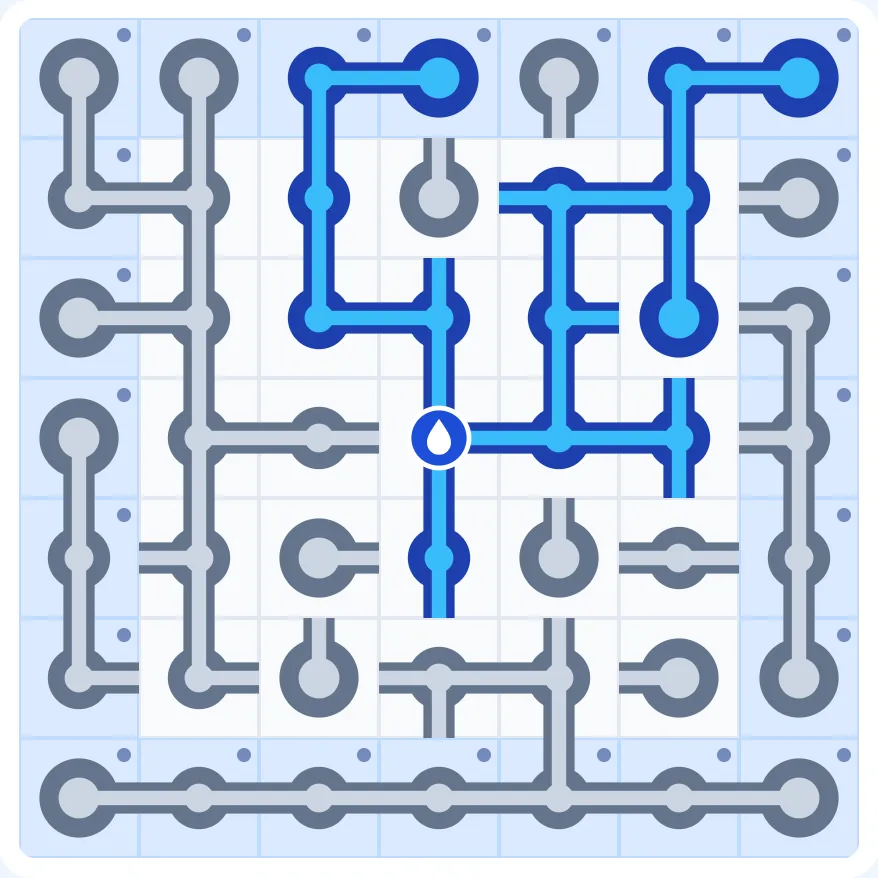
The edge of the board is where the puzzle gives itself away, because nothing may point off it. Work through what that leaves:
- A bend in a corner has exactly one way to face, into the board. So does a tee on an edge, with its flat side against the edge, and a straight on an edge, which has to run along it.
- A straight can never sit in a corner and neither can a tee, so you will not find one there.
- An end in a corner has two choices, and an end or bend on an edge has two or three.
Once a tile is settled, its neighbors know something too. Two tiles side by side must agree about the side they share: either both have a pipe there or neither does. Settle the corners and the edge tees, carry each shared side across to the next tile, and the answer creeps inward from all four sides at once. On this page that is the whole of an Easy puzzle. Nothing else is needed, and we check that before the board is published.
🚫 Two Dead Ends Never Face Each Other
An end tile has a single pipe. Put two of them side by side, pointing at each other, and they join into a tiny network of two tiles with no way out, sealed off from the tank forever. So wherever two end tiles are neighbors, neither can point at the other. On an edge, that one fact often removes the last wrong choice from an end tile.
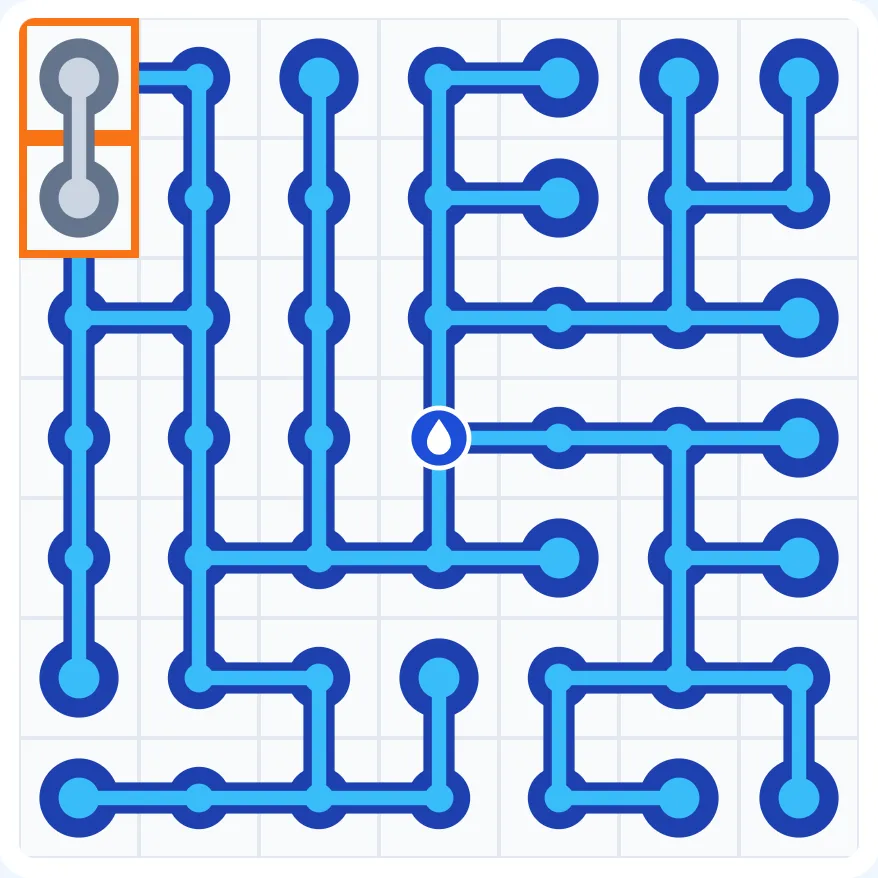
Medium puzzles are built so that you need this. An edges-only solver gets stuck on every one, with on average about 6 tiles still undecided on a 5 × 5, 10 on a 7 × 7, 12 on a 9 × 9 and 18 on an 11 × 11. Add the dead-end rule and it finishes every one.
🔁 Think in Groups: No Loops, No Sealed Pockets
Hard puzzles ask you to look beyond the next tile. Keep track of groups: tiles you have already proved are joined. Then two tests apply to every turn you are considering:
- Never close a loop. If a turn would join a tile to a group it already belongs to, that turn is wrong, however neat it looks.
- Never seal a pocket. Count the pipe ends of a group that still lead out of it. If a turn would join two groups and leave the combined group with no ends leading out, while it still doesn't hold the whole board, that turn is wrong. The dead-end rule is the smallest case of this one: two ends, one way out each, and the join uses up both.
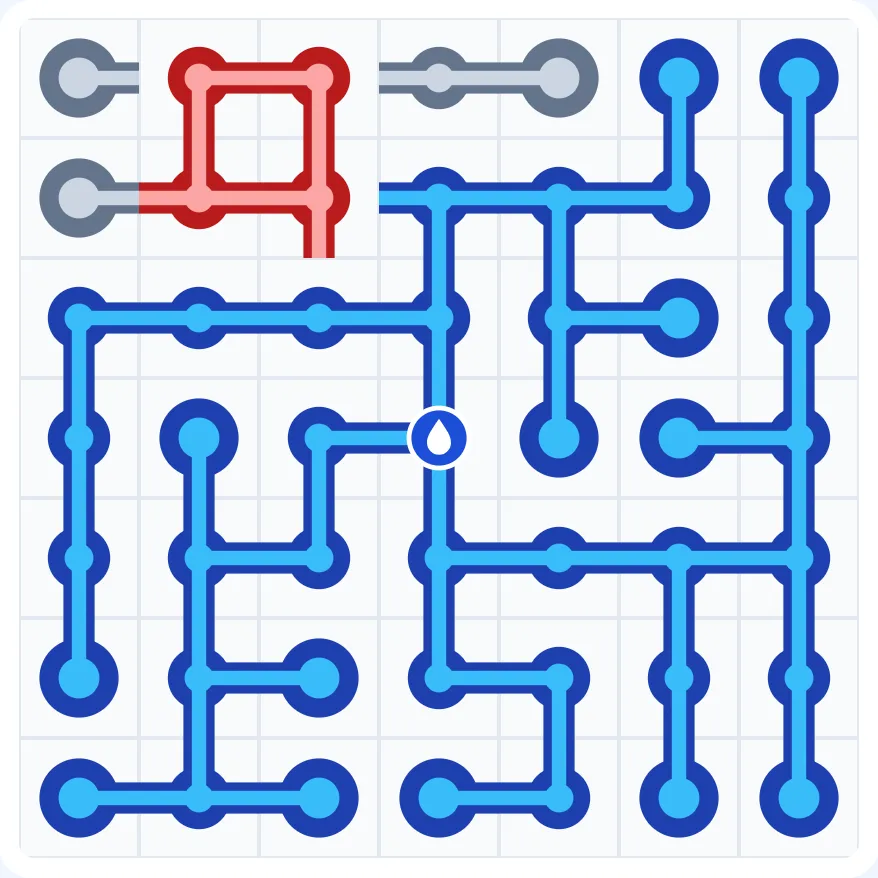
You need both. Across 200 Hard 11 × 11 boards, most gave way to either test on its own, but 37 could only be finished with the loop test, 25 only with the pocket test, and 6 needed the two together.
⚠️ Four Mistakes Worth Avoiding
- Solving outward from the tank. The blue water is a good progress bar and a poor strategy. The center has the most freedom on the board. The border has the least, and that's where you should start.
- Turning tiles to see what happens. Each tile has at most four ways to face, so turning tiles at random feels harmless. Do it across a 7 × 7 and you are searching an astronomical number of combinations. Prove a tile, then turn it.
- Forgetting that straights only have two faces. A straight is either across or up-and-down. That makes it one of the most decisive tiles on the board, and also one of the easiest to overlook.
- Accepting a network that is nearly all lit. If a single tile stays dark while everything around it glows, look for a loop or a pipe pointing into a blank side nearby. The count in the status bar tells you how many tiles the water reaches.
🎚️ What Easy, Medium and Hard Mean Here
Each level is a set of techniques, and every board is checked both ways before you see it: the level's own techniques must finish it, and the level below must not.
| Level | Techniques it needs | Where the level below gets stuck |
|---|---|---|
| Easy | The border and matching sides | (nothing below it) |
| Medium | Easy, plus dead ends never face each other | About 6, 10, 12 and 18 tiles left undecided |
| Hard | Medium, plus no loops and no sealed pockets | About 6, 9, 10 and 17 tiles left undecided |
The two right-hand figures are for 5 × 5, 7 × 7, 9 × 9 and 11 × 11 boards, averaged over 40 puzzles at each size and level.
Two honest notes. First, Hard here is a hard last stretch, not a wall of guesswork: the first two techniques settle most of the board, on average all but 6 of the 25 tiles on a 5 × 5 and all but 17 of the 121 on an 11 × 11. Second, a random network is not automatically a fair puzzle. When we grew networks the way this page does and counted their answers by brute force, roughly 5% of 5 × 5 networks had more than one answer, rising to about 15% on 7 × 7, 27% on 9 × 9 and 42% on 11 × 11. On a board like that you can be right and still be told you are wrong. Ours are thrown away before you see them, and in the 480-puzzle test the brute-force counter found exactly one answer every time.
🎮 Playing on This Page
Tap or click a tile to turn it clockwise. On a computer, right-click or press A to turn it back, and D turns it clockwise. To lock a tile, long-press it on a phone, Shift-click or middle-click it, press L, or switch on Lock mode so every tap locks instead of turning. The arrow keys move between tiles.
Hint turns one wrong tile the right way and locks it, and it picks tiles in the order the logic settles them, so the early hints come from the border just as your own reasoning should. Solution shows the finished network. Every board starts with about seven tiles in ten turned the wrong way; a 7 × 7 needs about 44 quarter-turns at the very least, and an 11 × 11 about 111.
📜 Where Pipes Comes From
One of the earliest versions was KPlumber, packaged with some Linux distributions and ported to Windows in 2000 as Linkz. The British programmer Simon Tatham met the idea as a Flash game called FreeNet, written by Pavils Jurjans, and in 2005 added it to his free Portable Puzzle Collection as Net. Many other versions go by NetWalk. Mathematicians have proved that solving it in general is NP-complete, and the same 2004 paper showed that the straight tiles are what make it so: take them away and a computer can solve any board quickly. Tatham's version lights up the tiles joined to the center, which is where this page's tank comes from.
🧒 A Good Puzzle for Younger Players
Pipes needs no numbers, no words and no arithmetic, and the water gives instant feedback: a tile you got right glows. A 5 × 5 Easy board has 25 tiles and can be finished with nothing but the border and matching sides, which teaches a habit worth having anywhere: begin with the piece that has the fewest choices. When the 7 × 7 starts to feel easy, try a Medium and look for those two dead ends. 🚰