⛵ How to Solve a Battleship Puzzle (Bimaru)
A Battleship puzzle hides a fleet of ships on a grid and gives you two rows of numbers: how many ship squares sit in each row and each column. From those counts, and the rule that ships never touch, you work out where every ship is. The puzzle goes by several names: Bimaru, Battleship Solitaire, Solitaire Battleships and Yubotu. They are all the same game.
📋 The Rules
- The fleet is listed above the grid. Every ship in it is hidden somewhere on the board, lying straight across or straight down.
- The number beside a row, or above a column, counts the ship squares in that line, not the ships.
- Ships never touch each other, not even at a corner. Every ship is surrounded by water.
- A few squares may be revealed at the start. A revealed ship square shows its shape: an end (rounded on one side, flat on the side where its ship carries on), a square middle, or a round submarine.
- Every puzzle on this page has exactly one answer.
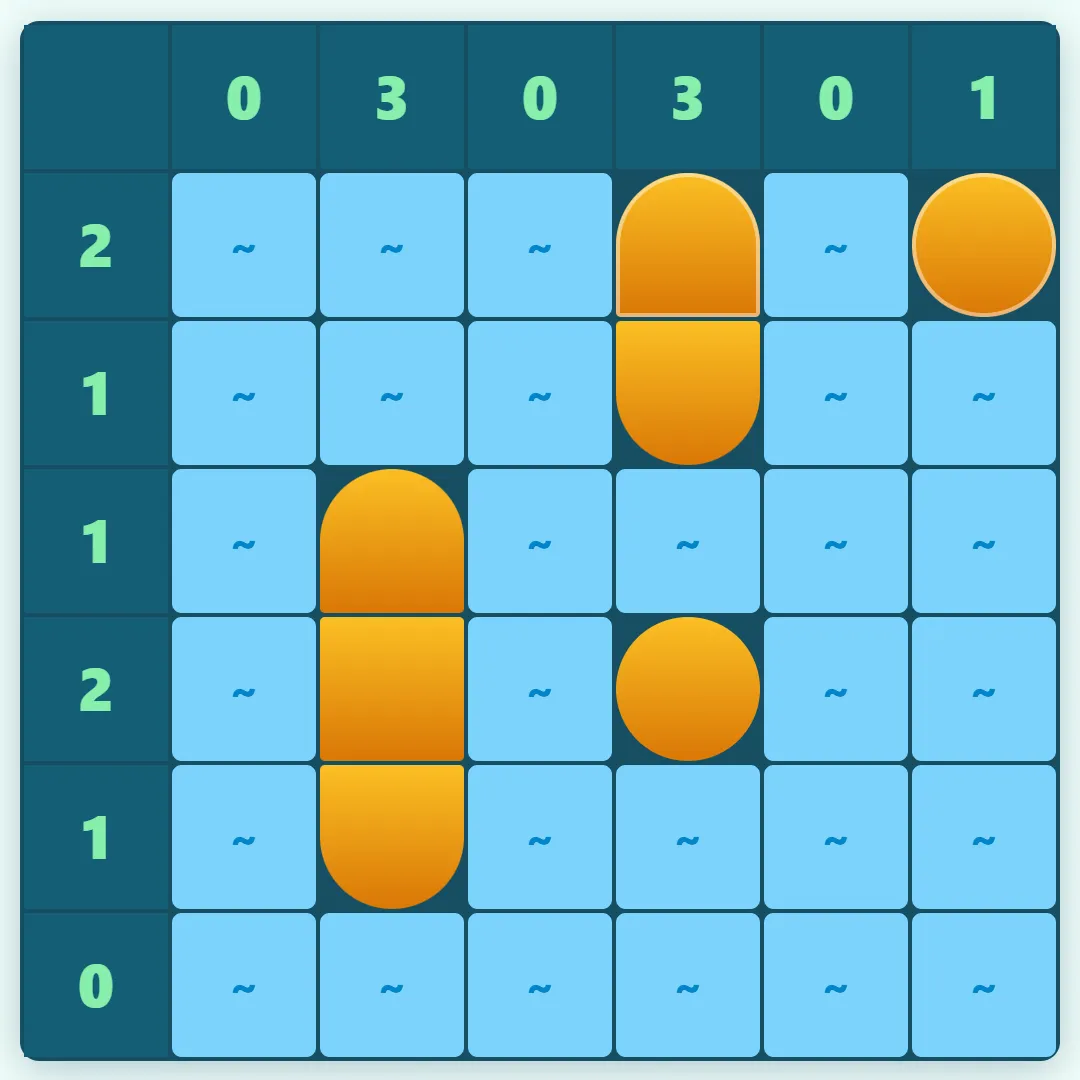
⚓ Not the Board Game You Know
The two-player board game is about calling shots and hearing "hit" or "miss". The puzzle has no opponent and no luck: the numbers on the edges tell you everything, and the job is to read them. Three habits from the board game will trip you up. The clues count squares, so a row marked 3 might hold one three-square ship or three submarines. The fleet is the one listed on this page, not the five-ship set from the box. And ships here can't sit side by side, which the board game usually allows.
🧭 Solving Techniques, in the Order You Need Them
Steps 1 to 4 finish every Easy puzzle here, steps 5 and 6 are what Medium adds, and step 7 is what Hard adds.
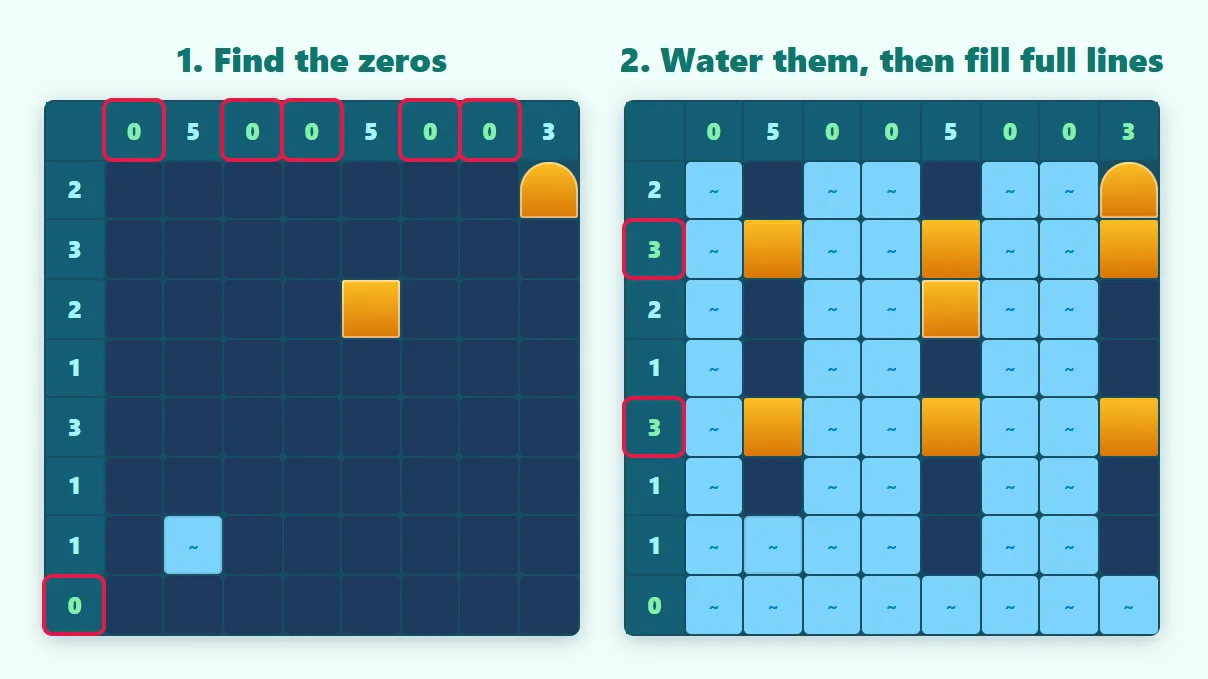
1. Water the zeros. A row or column marked 0 holds no ship at all, so every square in it is water. Do this first, every time. Every board on this page has at least one zero line, and they average about three.
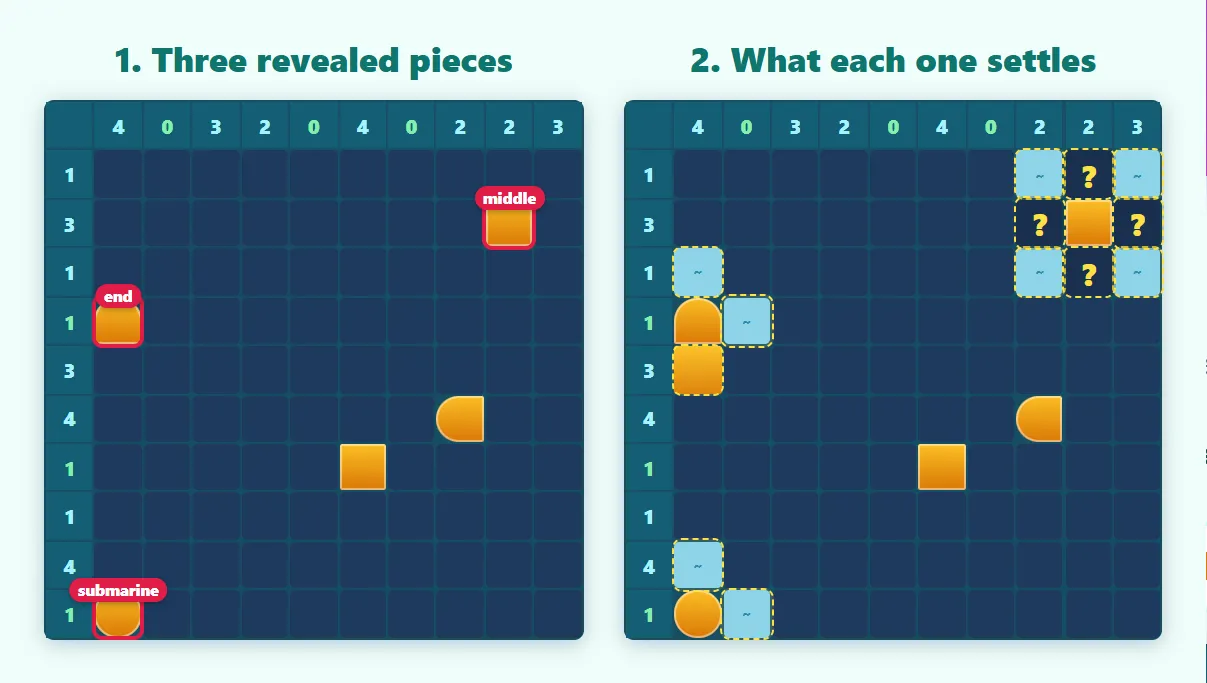
2. Read the revealed pieces. A revealed end piece is rounded on one side and flat on the other: the square past its flat side is ship, and its other three sides are water. A submarine has water on all four sides. A middle piece is the odd one: it is a plain square, so it tells you the ship runs on through it, but not whether across or down. If one of those two ways is blocked by water or the edge, it is the other.
3. Fill the full lines. Once the water is in, look for a line where the number equals the squares still open in it. A row marked 3 with exactly three squares left open has no choice: all three are ship.
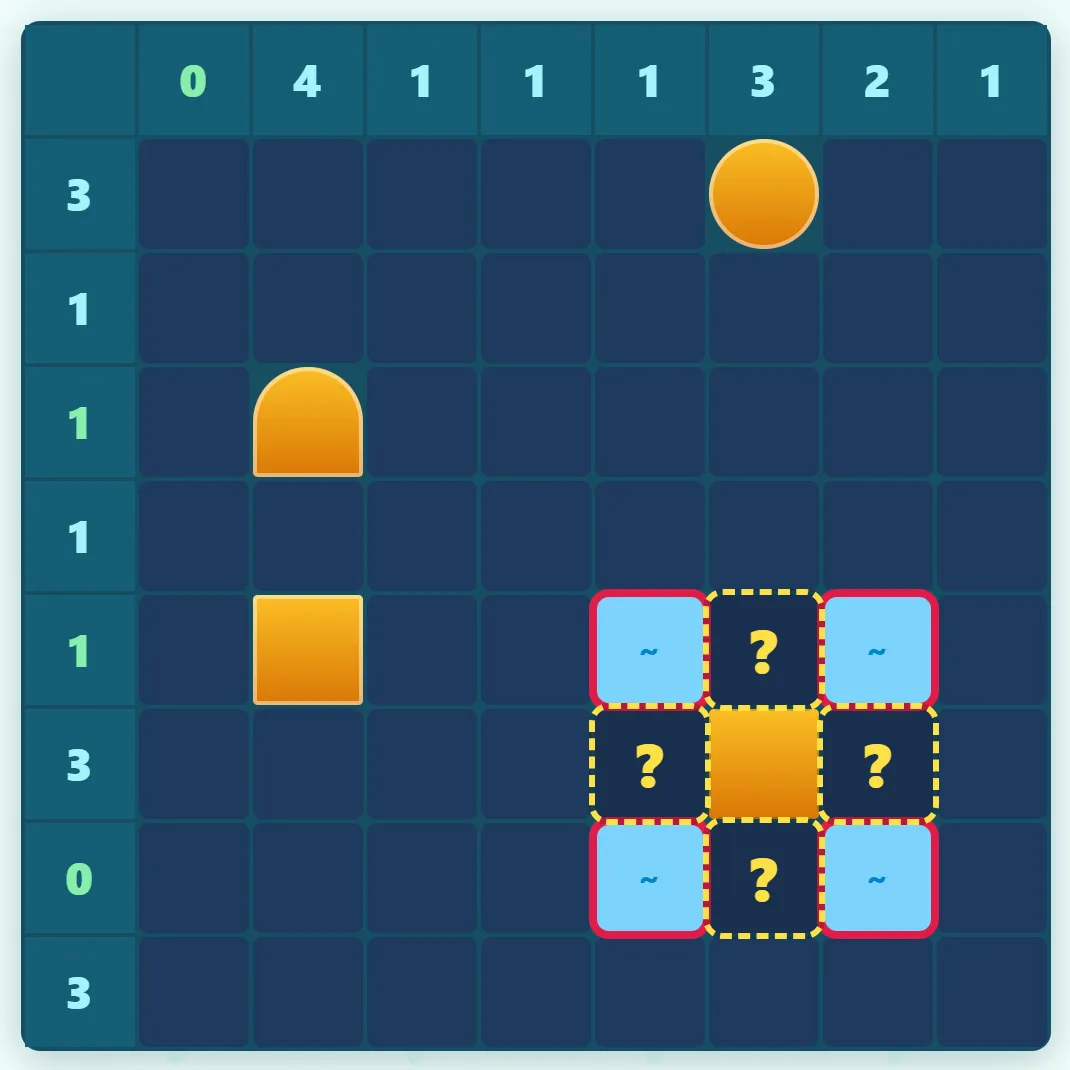
4. Water the corners. Because ships never touch diagonally, the four corner neighbors of any ship square are water. The squares directly beside it are a different matter: the ship may carry on there, so leave them open until another clue decides them.
5. Close off finished ships. When a run of ship squares is as long as the biggest ship you still need, or it has water at both ends, it is a whole ship. Put water on the square past each end and cross it off the fleet.
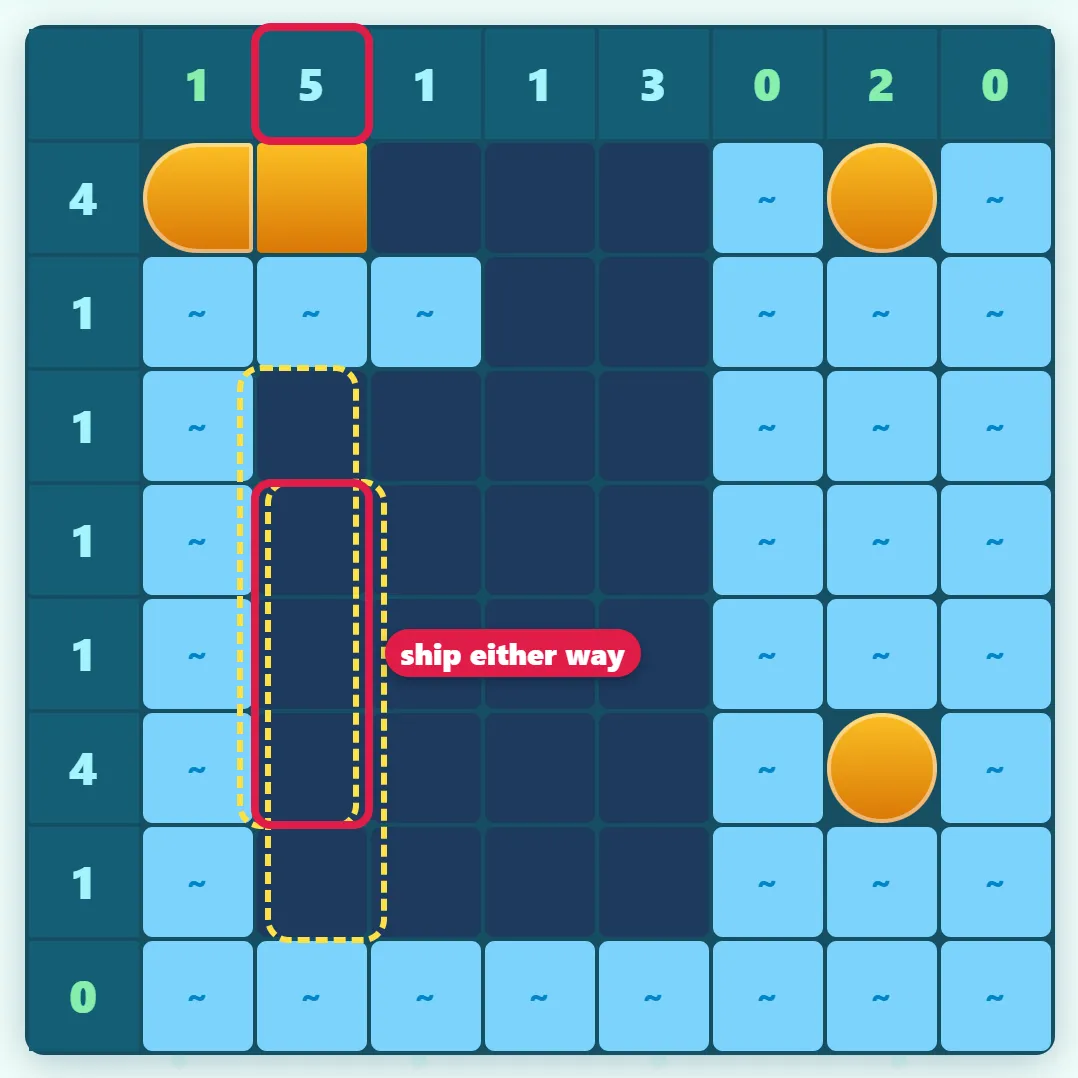
6. Find where the biggest ship fits. This is the technique that breaks a Medium stall. List the ships you haven't placed, take the longest, and look for every run of open squares long enough to hold it, in a line whose number has room for it. Often there are only one or two. If the only gap for a four-square ship is five squares long, it starts at one end or the other, and the middle three squares are ship either way. The same goes for any square no remaining ship can reach: it is water.
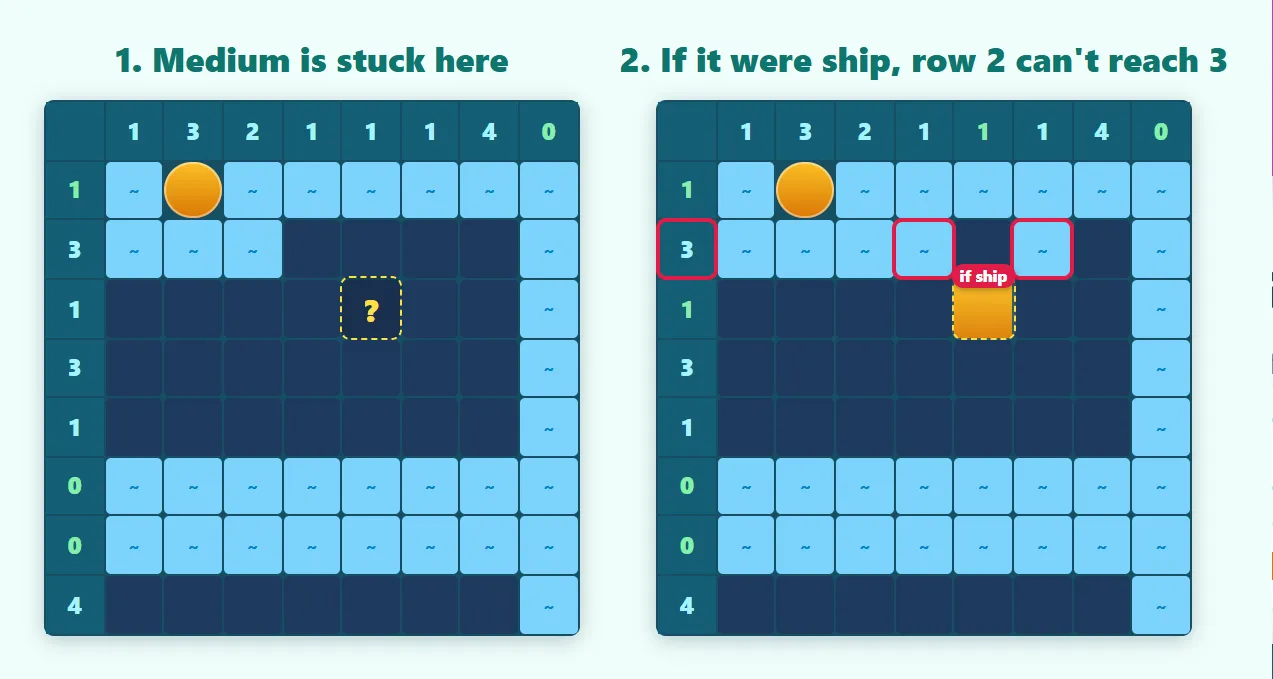
7. Ask "what if?" This is the Hard step. When nothing above is forced, pick an open square and suppose it is ship. Follow only the quick consequences: its corners become water, and lines fill or empty. If that leaves some row or column unable to reach its number, the square can't be ship, so it is water. It is one step of checking, not guessing: you never go deeper than the first round of consequences.
8. Repeat. Every new ship square brings new corner water, and every new water square can turn a line full. Go back to step 1 after each discovery.
⚠️ Common Mistakes
- Counting ships instead of squares. A column marked 2 can be one two-square ship or two submarines.
- Forgetting corner water. Two ships meeting at a corner breaks the rules, and it is the easiest break to miss.
- Assuming a middle piece's direction. A revealed square piece is the middle of a ship of three or more, but it doesn't say which way the ship runs. Rule one way out before you build the other.
- Filling a line before watering it. A row can look full until a zero column crosses it. Do the zeros first.
📐 Sizes, Fleets and Levels on This Page
The 10×10 uses the standard puzzle fleet. The smaller boards use trimmed versions of it:
- 6×6: four ships, seven squares (one each of 3, 2, 1 and 1).
- 8×8: six ships, thirteen squares (4, 3, 2, 2, 1, 1).
- 10×10: ten ships, twenty squares (one 4, two 3s, three 2s, four submarines).
The level decides which techniques a puzzle needs, not how much it shows you. The generator starts from the row and column numbers alone and runs a solver that knows only the techniques for the chosen level. Wherever that solver gets stuck, it reveals one square, until the solver can finish. Then it takes back every reveal the solver can do without. A puzzle the level below can also finish is thrown away, so:
- Easy can always be finished with steps 1 to 4.
- Medium always stalls with steps 1 to 4 and finishes with steps 1 to 6.
- Hard always stalls with steps 1 to 6 and finishes once you add step 7. The one exception is 6×6, where about 1 board in 20 can't be made to need step 7; those come out at Medium difficulty rather than not at all.
We checked this on 1,800 generated puzzles, 200 of each size and level. A separate brute-force checker, which tries every possible fleet, found exactly one answer for every one of them, and it was always the answer the game holds.
| Board | Squares revealed at the start (average) | Boards that start with nothing revealed |
|---|---|---|
| 6×6 Easy | 1.5 | 4% |
| 6×6 Medium | 1.0 | 19% |
| 6×6 Hard | 0.3 | 71% |
| 8×8 Easy | 3.1 | 0.5% |
| 8×8 Medium | 2.0 | 1% |
| 8×8 Hard | 1.3 | 12.5% |
| 10×10 Easy | 5.9 | 0% |
| 10×10 Medium | 4.8 | 0% |
| 10×10 Hard | 4.1 | 0% |
Two things in that table are worth knowing. A Hard board isn't hard because it shows you less: a 10×10 Hard shows more than a 6×6 Easy. It is hard because of the step it needs. And most 6×6 Hard boards give you nothing but the numbers, which is a good test of whether steps 1 to 7 really are enough. They are.
🎮 How to Play on This Page
- Click or tap a square to cycle it: empty → ship → water → empty. Right-click toggles water directly.
- A number turns green when its line has the right count of ship squares, and red when it has too many.
- A ship square you place stays square on any side you haven't decided, and rounds off once that side is water or the edge. So a square you have placed on its own reads as "ship, length unknown", and it only turns into a round submarine when you have watered all four sides.
- The fleet bar above the grid turns each ship green once you have placed a straight ship of that length. A revealed end or middle piece counts only once its whole ship is in.
- Revealed squares have a faint inner ring and can't be changed.
- A short "Building a puzzle…" message shows while a new board is made. A 10×10 Hard takes the longest: on a laptop, nine boards in ten take under a tenth of a second.
- 💡 Hint fills one square from the answer. It shows a ship square you haven't placed first, then one of your ship squares that should be water, then water. Because each puzzle has only one answer, a hint never contradicts a correct board. 👀 Solution shows the whole fleet.
🌎 Where Battleship Puzzles Come From
The puzzle was invented in Argentina by Jaime Poniachik and first printed in 1982 in the magazine Humor & Juegos, under the name Batalla Naval. It reached an international audience at the first World Puzzle Championship, held in New York in 1992, and GAMES magazine began running it in 1993. Bimaru and Yubotu are names other publishers print it under; Battleship Solitaire and Solitaire Battleships are the usual English ones.
🧒 Starting Younger Players
The 6×6 Easy board is a good first logic puzzle for a child who can count to seven. There are four ships, and every one of those boards comes out with four rules a child can say out loud: zeros are water, a full line is ship, the corners of a ship are water, and a revealed piece shows which way its ship goes. The green numbers confirm each line as it is finished, and because there is only one answer, the win message always comes when the board is right.
Start on 6×6 Easy, water the zeros, and see how far the corners take you. ⚓